Key facts: Emergency Water Extraction
- Removing liquid water first shortens drying, because evaporating it takes far longer.
- The line connects you with an independent contractor at any hour, including holidays.
- Water from toilets, drains or outdoors should be treated as contaminated.
Why hurry
Why standing water is called in first
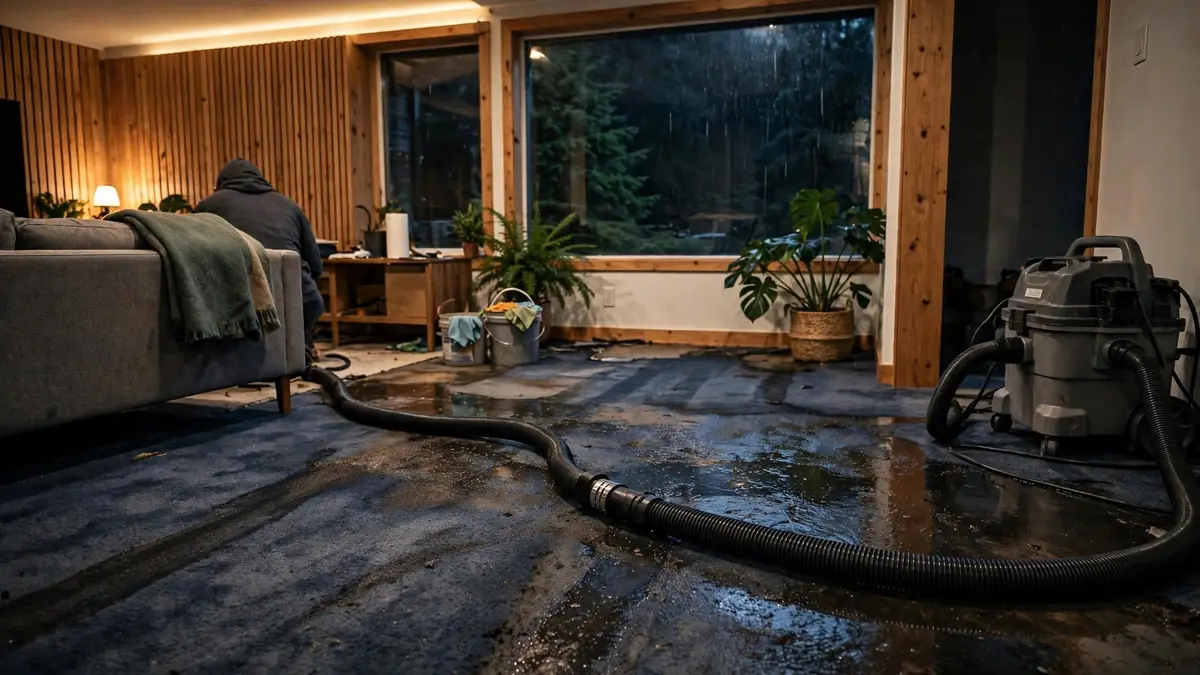
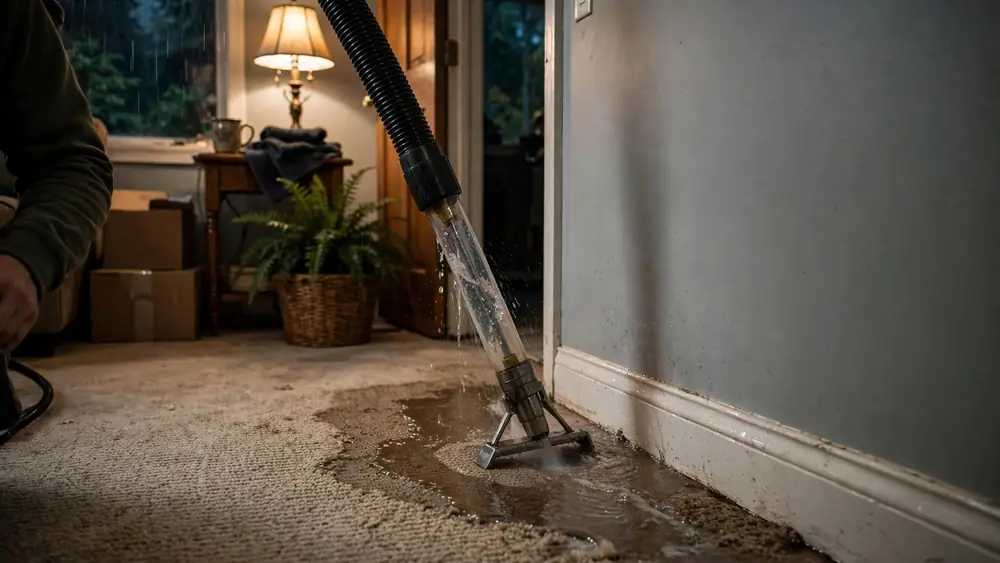
A pool of water on carpet or hardwood is still moving. It wicks up drywall, seeps under baseboards and works its way into subfloors and, in many Oregon homes, down to the crawlspace. Pulling it out with pumps and extractors removes far more moisture in an hour than fans remove in days. That is why extraction always comes before drying equipment, and why a call at midnight can be worth it even if the visible water looks shallow.
The crew will usually want to know how deep the water is, what floor it is on and how far it has spread. A rough answer is fine. Saying "it is about an inch deep in two rooms and coming through to the basement" helps them bring the right pump as well as the carpet wand.
Where from
Clean, gray or contaminated: tell them what you know
Where the water came from changes the job. A broken supply line starts out as clean water. A washing machine overflow or dishwasher leak is a step down. Water from a toilet, a floor drain or a flooded yard is treated as contaminated, and porous materials it touched may have to go. Even clean water gets worse if it sits for a day or more, so mention how long it has been there.
You do not have to work this out alone. Say what you saw on the call: where it first appeared, whether it smells and whether it has rained heavily. The contractor can tell you what precautions to take until the crew gets there.
On arrival
What the first hour usually looks like
- 1
Safety check
Power, gas and ceilings are checked before the crew walks in.
- 2
Source
The crew confirms the water has stopped before setting up.
- 3
Removal
Pumps handle deep water, then wands pull water from carpet and pad.
- 4
Measuring
Moisture readings mark how far the water really travelled.
Meanwhile
Useful things to do while you wait
Move small, valuable things up and away from the water if you can reach them without wading: documents, photos, medication, laptops. Pin up curtains that touch the floor. Put furniture legs on foil or plastic to stop stains transferring. Clear a path from the front door to the wet rooms, since hoses will need to run through, and move the car if the driveway is narrow. A truck-mounted unit may need to park close.
Do not use a household vacuum, and do not lift wet carpet by yourself. Wet carpet and pad are heavy and hide slip hazards. A shop vac is reasonable only for shallow clean water, away from any electrics, and only if you are running it from a safe outlet.
Floors
What happens to carpet, hardwood and crawlspaces
Carpet can often be saved when clean water is pulled out quickly, though the pad underneath is commonly replaced. Hardwood needs a different approach, since boards start cupping as they absorb water, so tell the crew about any wood floors up front. Vinyl plank can trap water beneath it where it looks fine on top.
Older Oregon homes often sit over a vented crawlspace, and water that goes through the floor does not stop at the subfloor. Ask the crew to check below before they leave. Water in insulation or on a vapor barrier can stay there for weeks if nobody looks. The crawlspace water damage page explains that follow-up.
Tell the crew
Details that change what they bring
- Which floor the water is on, and whether there is a stairway
- Whether a basement or crawlspace is below
- Roughly how deep and how many rooms
- Any stairs, gates or parking limits
- Pets or people who need to stay in the home
Records
Keep the evidence while water is being removed
Ask the crew to photograph the water before it is gone, and take your own wide shots. Insurers want to see how much water there was and where. Keep any receipts, and ask for the moisture readings and a list of the equipment used. Those records usually matter more later than they seem to at 3 a.m. The EPA advises getting wet materials dry within 24 to 48 hours to limit mold, so a record of when extraction started can be useful too [1].
Rooms
When the water is upstairs
Water on an upper floor brings its own risks. It will find its way through the floor and into the ceiling below, usually along joists and around light fixtures. Stay out from under any ceiling that is bulging or dripping heavily, and do not poke it unless a crew has told you to. Keep the lights off in that room. A second-floor laundry or bathroom leak can look small above and still leave the kitchen below soaked, so ask the crew to check both levels and to give you readings for each. Move anything valuable out from below the wet area first, starting with electronics and anything made of paper.
Follow-up
After the water is gone
Dry-looking is not the same as dry. Once extraction ends, carpet and floors may feel only damp while the framing and subfloor still hold a lot of moisture. Air movers and dehumidifiers usually follow straight away and may run for several days, and they will be noisy. Leave them running and leave the settings alone unless the crew tells you otherwise. If power trips or a machine stops, call the number you were given. Keep windows closed if the crew asks, since damp outside air during an Oregon winter can slow things down. The structural drying page explains how the crew decides when the job is finished, using readings instead of guesses.
FAQ
Emergency extraction questions
Is someone available on a holiday?
Yes. The line connects you with an independent contractor every day, including holidays.
Can I use a shop vac first?
For a small amount of clean water away from electrics, yes. Leave contaminated or deep water to the crew.
Will all the carpet need replacing?
Not always. It depends on the water source, how long it sat and the condition of the pad.
Do I need to leave the house?
Stay out of wet rooms. If power is off, sewage is involved or the air is bad, stay elsewhere.